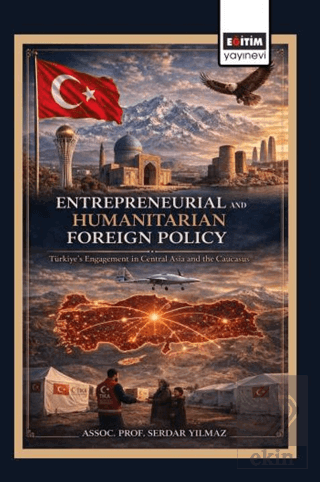
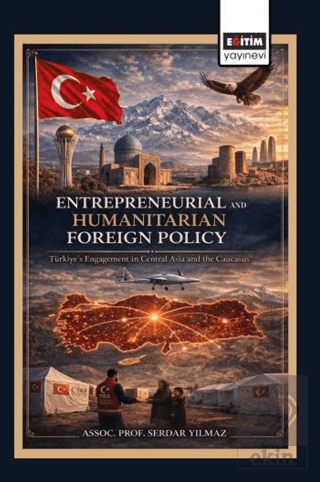
The disintegration of the Soviet Union fundamentally transformed Eurasia and created new opportunities for Türkiye's regional engagement. Over the past three decades, Türkiye has formulated a multidimensional foreign policy towards Central Asia and the Caucasus, which integrates economic cooperation, cultural diplomacy, development assistance, and humanitarian involvement. This approach has established a complex network of political, economic, and social connections throughout the region.
This book explores the mechanisms through which such engagement is created and maintained. It moves beyond conventional explanations rooted in military dominance or economic dependency, positing that influence in Eurasia frequently arises through the establishment of networks across various domains. In this framework, Türkiye's strategy is conceptualized as ecosystem diplomacy, wherein diverse policy instruments collaboratively function to generate cumulative influence. Consequently, Türkiye is more accurately characterized not as a traditional hegemonic actor, but as a hybrid power operating across economic, political, and socio-cultural spheres.
-
-
%15İNDİRİM800,00 680,00
The disintegration of the Soviet Union fundamentally transformed Eurasia and created new opportunities for Türkiye's regional engagement. Over the past three decades, Türkiye has formulated a multidimensional foreign policy towards Central Asia and the Caucasus, which integrates economic cooperation, cultural diplomacy, development assistance, and humanitarian involvement. This approach has established a complex network of political, economic, and social connections throughout the region.
This book explores the mechanisms through which such engagement is created and maintained. It moves beyond conventional explanations rooted in military dominance or economic dependency, positing that influence in Eurasia frequently arises through the establishment of networks across various domains. In this framework, Türkiye's strategy is conceptualized as ecosystem diplomacy, wherein diverse policy instruments collaboratively function to generate cumulative influence. Consequently, Türkiye is more accurately characterized not as a traditional hegemonic actor, but as a hybrid power operating across economic, political, and socio-cultural spheres.
| Taksit Sayısı | Taksit tutarı | Genel Toplam |
|---|---|---|
| Tek Çekim | 368,00 | 368,00 |
| 2 | 191,36 | 382,72 |
| 3 | 132,48 | 397,44 |
| Taksit Sayısı | Taksit tutarı | Genel Toplam |
|---|---|---|
| Tek Çekim | 368,00 | 368,00 |
| 2 | 191,36 | 382,72 |
| 3 | 132,48 | 397,44 |
-
-
-
%8İNDİRİM395,00 363,40
-
%8İNDİRİM688,00 632,96
-
%8İNDİRİM484,00 445,28
-
%8İNDİRİM484,00 445,28
-
%8İNDİRİM605,00 556,60
-
%8İNDİRİM605,00 556,60
-
-
%8İNDİRİM605,00 556,60